




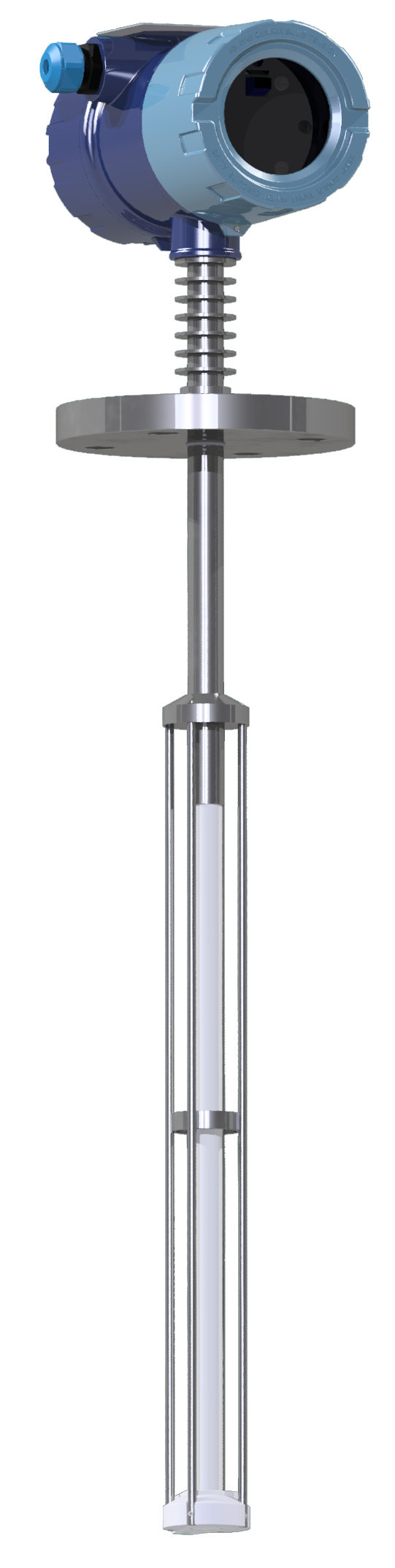
- Continuous, impedance-based interface level measurement between two immiscible liquids (e.g. organic/aqueous) in decanters and separators
- Interface level bar probes Industry Process measurement technology for automation
- Measuring principle: Impedance measurement via real-time recording of electrical properties (conductivity, dielectric constant), non-capacitive.
- Used for precise phase position determination in emulsions, phase inversion and changing process conditions
- Continuous real-time measurement of the interface height without moving parts; insensitive to depositsand coatings.
Fast interface level – measurement for demanding chemical processes with Swiss precision
Process-specific rod probes for continuous real-time separation layer detection
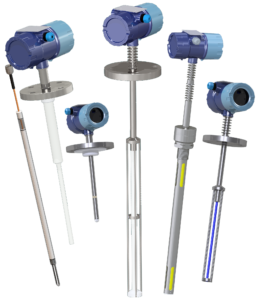
The Aquasant rod probe is the reliable partner for precise interface measurement and continuous phase separation in complex chemical applications. Developed for use in decanters and separators, this bar probe impresses with its robust design made of stainless steel, alloy or tantalum and a highly resistant coated measuring electrode.
Especially in processes with emulsions and phase inversions, which often occur in chemical extractions, the rod probes ensure reliable, long-lasting performance and measurement accuracy.
Is the Aquasant sensor a capacitive interface level measurement?
- Complex impedance (real and imaginary component)
- Conductivity (for conductive phases)
- dielectric properties of the two phases
What does an impedance interface level sensor measure?
How does the impedance interface measurement work?
Does the probe detect interfaces despite emulsions?
What are the advantages of an impedance probe compared to floats?
How easy is commissioning?
Are the probes chemically resistant?
Does the measurement work in batch and continuous decanters?
Does the measurement react to changes in density?
How much maintenance is required?
What criteria determine the right choice of sensor?
Why is precise detection with the interface level bar probe crucial?
Product phase mixing leads to considerable costs and contamination of the organic phase
Process optimization is essential for time-saving, efficient production. The degree of automation with the continuous interface rod probe in the decanter allows the continuous product separation to be operated autonomously. The continuous feed flow into the decanter is controlled by the overflow and the regulated outlet via a control valve in the lower phase.
Advantages of the interface level sensor for maximum process control
The continuous interface rod probe type: STMd-R, ensures precise detection and control of the phase height in the separator. This automatic adaptation to specific process requirements enables you to optimally control the phase separation and thus significantly increase the efficiency of your decanter processes. Seamless integration into your existing process infrastructure ensures minimal downtime and rapid implementation.
General advantages
- Highest measuring accuracy for any conductivity
- Real-time interface measurement
- Insensitive to emulsions & coatings
- Ex ia certified for zone 0/1 for substance group IIC T6
- Maintenance-free thanks to optimized design
- Customized length (up to 6 m)
- Ideal in mono and multi-purpose systems
High-quality materials for extreme conditions
The interface rod probes are designed to function reliably even under extreme conditions. The combination of stainless steel or alloy and an FFKM double sealing system and a Teflon measuring electrode offers exceptional resistance to aggressive chemical environments. This makes the STMd-R sensor the ideal choice for demanding applications where reliability and longevity are critical.
Customized selection options
The process conditions set the path.
The chemical product type and process parameters such as pressure and temperature are decisive for probe materialization and dimensioning.
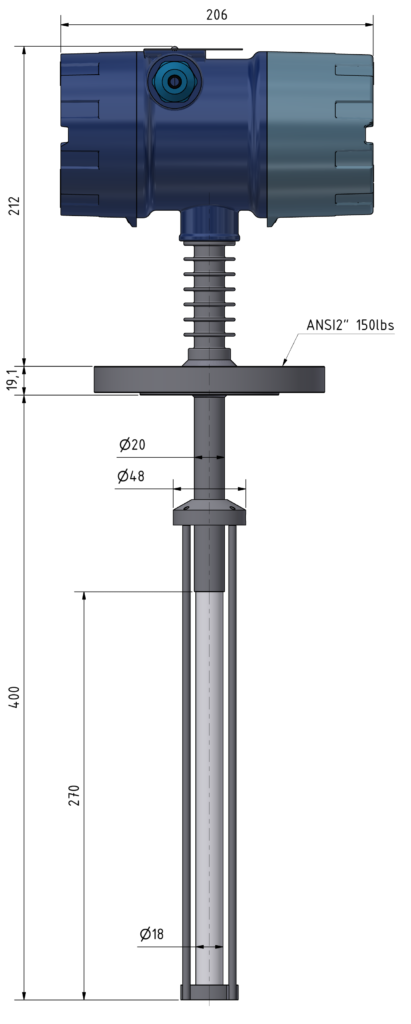
Decanter dimensions determine the process connection, active measuring length and total length. The basic requirement of 100% product coverage of the active measuring range must be met.
The 4-rod reference electrode includes the measuring field lines of the impedance measurement.
Specifications
- Physical measuring principle: Impedance
- Process connections: Flanges or threads (metric/inch)
- Process pressure: 0.5 to +40 bar
- Measuring range: 40 to 3000 mm
- Temperature: -20 to +170 °C
- 2-wire technology
- ATEX Ex ia-approved for zone 0/1
Application variants of interface level sensor
Aquasant sensors are designed and produced exclusively in-house. The process conditions and products of the system are taken into account. We define the optimum sensor through personal consultation and process queries.
- High-temperature ceramic SKMd rod probe up to 170°C
- Full PTFE STMd-T rod probe for aggressive products
- SGK rod probe mini glass sensor for mixer-settler applications
- Product compensated STMd rod probes of one phase
- SEM rod probe with glass-lined measuring electrode for high temperature application
- Interface detection clamp sensor for glass apparatus
Areas of application
Continuous separation processes of organic and aqueous phases in decanters and columns in the chemical and pharmaceutical industries, oil-water separation in refineries
- Chemicals
- Petro Industry
- Pharmaceuticals
- Production
- Refinery

“Learn more about precise interface measurement and optimize your phase separation with the STMd bar probe. Contact us now for an individual consultation and maximize the efficiency of your chemical processes.”
– Managing Director
Overview of the various interface level sensor
No products were found for your selection.
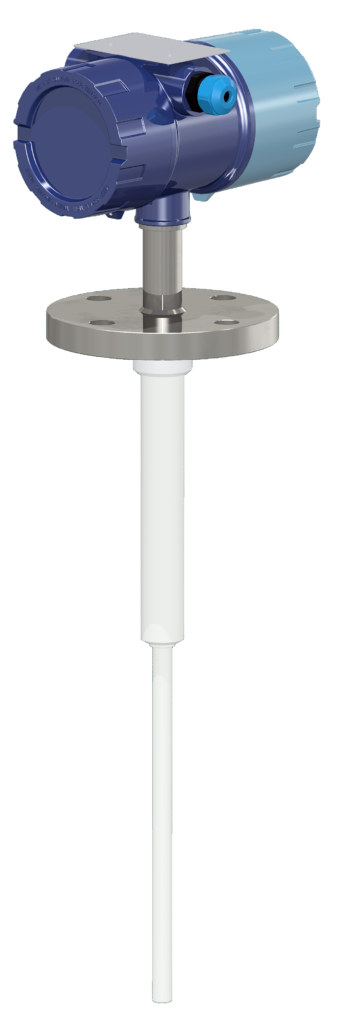
STMd SB T TN DN
Information
Technical Data
Documentation
Accessoires
Information
Advantages of phase separation with Aquasant sensors
- High measuring accuracy: The impedance measurement reliably detects even the smallest differences in density and mulch layers.
- Reliable phase monitoring: Continuous phase monitoring takes place online and ensures automatic, fast and reliable detection of the interfaces, even under difficult conditions.
- Universal use: Our rod probes are versatile – in decanters, mixer-settlers, columns or pipelines.
- Simple integration: Easy commissioning and the self-monitoring measuring and control unit guarantee reliable liquid/liquid phase separation in various industrial processes.
Control units
MIL 8130 | MIQ 8130
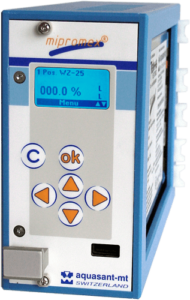
MIPROMEX – The all-rounder for interface measurement
The MIQ evaluation unit can be used for everything from interface level measurement to batch separation with a pipe probe. With the option of a 2nd measuring circuit, phase monitoring, the fill level or the separation behavior can be measured. The evaluation electronics not only serve as a power supply unit in 2-wire technology, but also contain the intelligence for data processing.
Your advantage: High cost-effectiveness and investment security thanks to a long service life.
- Universally applicable, reduced storage costs
- With 1 or 2 measuring inputs
- Fault visualization, fault messages can be set to analogue output
- Monitored measuring circuit from probe to relay
- Analog output 4 – 20 mA with galvanic isolation, max. load 750 Ohm
- 2 relay outputs with potential-free changeover contact Limit value on first measuring circuit
- Continuous interface monitoring
- Phase monitoring for safety-optimized separation
- Combination with level measurement of the upper phase
Ex version: SEV 22 ATEX, EMC, CE
Technical Data
-
Dimensions- DN25-165
- ANSI 1"-5"
or according to process specification:
- Thread M/G/R/NPT (metric/inch)
- Triclamp
- Milk pipe fitting -
Pipe classShape according to EN 1092-1
ASTM A182, ASME B16.5 RF -
Probe materialStainless steel 316L
or according to process specification:
Alloy C22 (2.4602), tantalum, zirconium -
Measurement electronicsconstructed aluminum
-
Protection classIP 68 (0.2 bar)
-
Ambient temperature-20.. 60°C
-
Measurement principleImpedance
-
Process temperature range-20..100°C standard
-30..180°C with heat sink -
Process pressure range-0.5..300 bar
-
SealsFKM (VITON)
FFKM (Chemraz, Kalrez) -
Measuring electrode materialenamel
Glas
Halar
ceramic
PFA
PTFE
FEP -
Maximum measuring length40 .. 3000 mm
-
Measuring rangeDK >1.8
-
Conductivity rangeorganic phase at TN: 0..50 µS/cm (constant)
-
Integration time40-400 ms
-
Ex-proofIntrinsic safety "i"
Flameproof enclosure "d" -
Scope of applicationATEX / Europe
IEC / worldwide
UKCA Great Britain -
CertificatesDeclaration of conformity (FDA/EU1935)
Confirmation TSE/BSE free
Pressure test certificate
Manufacturer conformity PED/DESP/PED
Tool certificate 2.2 (EN 10204)
Acceptance test certificate 3.1
Test certificate ferrite content
Test certificate surface quality roughness
Test certificate welded joint -
Electrical outputsmipromex: 4-20 mA active/2 GW USK relay or OC
MTI: Pulse
Documentation
PDF Downloads
 PDF Downloads
Accessoires
- mipromex evaluation unit type: MIQ/MIL 8130
- Monorack top-hat rail enclosure type: MRM 2
- Local measuring electronics type: MTI 50/1 AEO2 K